

WISE project
WISE is a four-year international Horizon Europe project that develops research collaboration in the field of urban sustainability among the universities of the Transform4Europe (T4EU) alliance. Within the project, the EKA Centre of Competence for Wood Architecture PAKK focuses on developing the timber joints of the Mustermaja building system, teaching the system, and producing international learning materials. Together with InnoRenew researchers and the Slovenian manufacturer iQwood, test modules of the Mustermaja system will be designed and installed on the roof of the InnoRenew building to study the solutions at building scale.
Project implementation: EKA Centre of Competence for Wood Architecture PAKK and the EKA Research and Development Department
Research team: Renee Puusepp, Anna Tommingas
Project management: Pille Epner (responsible at EKA), Kristi Mets-Alunurm (coordinator)
Period: 01.09.2026 – 31.08.2030
Funding: European Union research and innovation programme Horizon Europe, WIDERA action – European Excellence Initiative (total project budget €4.98 million)
Coordinator: University of Primorska (Slovenia)
Project description
WISE brings together 16 organisations: 11 higher education institutions and five partners from business, the public sector and civil society across Europe. The project strengthens research collaboration between universities and creates opportunities for joint research, training and knowledge transfer. Its thematic focus is on urban sustainability, including resource-efficient construction and the quality of the living environment.
PAKK links the project’s research to Mustermaja, an open industrial timber construction system that allows buildings to be assembled from repeatable components and supports the development of their adaptability, demountability and reuse. Within WISE, timber joints are being developed based on the needs of the Mustermaja system, and the knowledge needed to use the system is shared with architects, municipalities and other partners across Europe.
The development of timber joints takes place within the WISE research strand WELCOME, in collaboration with the University of Primorska’s InnoRenew centre and iQwood. The research examines thermo-hydro-mechanically densified shape-memory wood dowels, whose properties can be used to create adhesive-free timber connections. One line of research is dowel-laminated timber (DLT). The aim is to develop metal-free and adhesive-free connections and to assess their structural performance, manufacturability and suitability for circular construction.
PAKK brings to the collaboration an architectural perspective that considers the building system as a whole: how the new joints can be applied in Mustermaja components, how they are manufactured and installed, and what possibilities arise for disassembling and reusing the components. Material and joint tests are carried out together with the partners.
At the kick-off meeting, it was agreed that iQwood will manufacture Mustermaja test modules, which will be installed on the roof of the InnoRenew building. The test modules make it possible to link joint development with actual construction and to study how the solutions perform at building scale. The collaboration also includes research on the building’s acoustic performance and sound environment. Mustermaja serves as a concrete application of the development work, through which the broader applicability of the solutions in timber construction is explored.
The second key area of activity is delivering training and producing learning materials. Using Mustermaja as an example, the principles of circular construction, component-based design, demountability and reuse are addressed. The wider application context is adaptable social infrastructure, including schools, kindergartens and care homes for the elderly.
In the project, the EKA Research and Development Department supports the development of research and project management capacity, international collaboration, and the advancement of open science and research assessment practices.
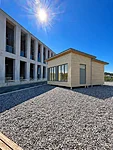
WISE brings together 16 organisations: 11 higher education institutions and five partners from business, the public sector and civil society across Europe. The project strengthens research collaboration between universities and creates opportunities for joint research, training and knowledge transfer. Its thematic focus is on urban sustainability, including resource-efficient construction and the quality of the living environment.
PAKK links the project’s research to Mustermaja, an open industrial timber construction system that allows buildings to be assembled from repeatable components and supports the development of their adaptability, demountability and reuse. Within WISE, timber joints are being developed based on the needs of the Mustermaja system, and the knowledge needed to use the system is shared with architects, municipalities and other partners across Europe.
The development of timber joints takes place within the WISE research strand WELCOME, in collaboration with the University of Primorska’s InnoRenew centre and iQwood. The research examines thermo-hydro-mechanically densified shape-memory wood dowels, whose properties can be used to create adhesive-free timber connections. One line of research is dowel-laminated timber (DLT). The aim is to develop metal-free and adhesive-free connections and to assess their structural performance, manufacturability and suitability for circular construction.
PAKK brings to the collaboration an architectural perspective that considers the building system as a whole: how the new joints can be applied in Mustermaja components, how they are manufactured and installed, and what possibilities arise for disassembling and reusing the components. Material and joint tests are carried out together with the partners.
At the kick-off meeting, it was agreed that iQwood will manufacture Mustermaja test modules, which will be installed on the roof of the InnoRenew building. The test modules make it possible to link joint development with actual construction and to study how the solutions perform at building scale. The collaboration also includes research on the building’s acoustic performance and sound environment. Mustermaja serves as a concrete application of the development work, through which the broader applicability of the solutions in timber construction is explored.
The second key area of activity is delivering training and producing learning materials. Using Mustermaja as an example, the principles of circular construction, component-based design, demountability and reuse are addressed. The wider application context is adaptable social infrastructure, including schools, kindergartens and care homes for the elderly.
In the project, the EKA Research and Development Department supports the development of research and project management capacity, international collaboration, and the advancement of open science and research assessment practices.

Project objectives
1. Developing timber joints for Mustermaja
2. Test modules and testing at building scale
3. Training, learning materials and knowledge transfer
4. Research collaboration and building EKA’s capacity
Project partners
In addition to the Estonian Academy of Arts, the WISE consortium includes the University of Primorska, Universidade Católica Portuguesa, the University of Silesia in Katowice, Vytautas Magnus University, Sofia University St. Kliment Ohridski, Mariupol State University, Saarland University, the University of Alicante, the University of Trieste and Jean Monnet University, as well as five non-academic partners: iQwood, the Ljubljana Urban Region Development Agency, the City of Saarlouis, AISPECO and InnovaWood.
1. Developing timber joints for Mustermaja
- Develop metal-free and adhesive-free timber joints suited to the Mustermaja system in collaboration with InnoRenew and iQwood.
- Investigate the use of densified shape-memory wood dowels and DLT solutions in Mustermaja components.
- Together with partners, assess the mechanical performance, manufacturability and ease of installation of the solutions, as well as the possibilities for disassembly and reuse.
- Contribute to design guidelines based on test results.
2. Test modules and testing at building scale
- Design Mustermaja test modules to be manufactured by the Slovenian partner iQwood.
- Install the test modules on the roof of the InnoRenew building.
- Study the performance of the new solutions at building scale, including assembly, structural solutions and acoustic performance.
3. Training, learning materials and knowledge transfer
- Deliver training introducing the Mustermaja system and the principles of circular construction.
- Produce internationally usable learning materials on component-based design, demountability and reuse.
- Address the application of the system in the design of adaptable social infrastructure.
- Introduce the Mustermaja system to European architects, municipalities and other partners.
4. Research collaboration and building EKA’s capacity
- Strengthen collaboration between universities, the timber industry and the public sector, and prepare new joint research and development projects.
- Develop the skills of researchers and support staff through training and international mobility.
- Contribute to open science, FAIR data management and knowledge transfer practices.
- Analyse research assessment in light of the CoARA principles, with attention to practice-based research, design and creative outputs, and societal impact.
Project partners
In addition to the Estonian Academy of Arts, the WISE consortium includes the University of Primorska, Universidade Católica Portuguesa, the University of Silesia in Katowice, Vytautas Magnus University, Sofia University St. Kliment Ohridski, Mariupol State University, Saarland University, the University of Alicante, the University of Trieste and Jean Monnet University, as well as five non-academic partners: iQwood, the Ljubljana Urban Region Development Agency, the City of Saarlouis, AISPECO and InnovaWood.
